Caution is warranted when predicting U.S. success in foreign military operations. Vietnam, Afghanistan, and Iraq remain sobering reminders.
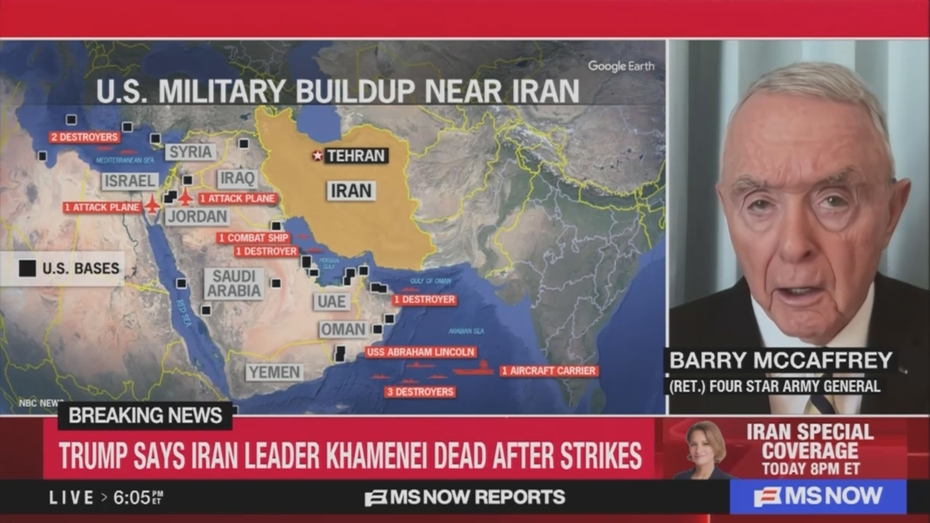
But appearing on MS NOW’s continuing Iran coverage last night, retired Gen. Barry McCaffrey — Bill Clinton’s former drug czar — took pessimism to new heights. In roughly two minutes, McCaffrey declared success in key American objectives in Iran “unlikely” four separate times — and added a “not likely” for good measure.
To be sure, McCaffrey began by acknowledging what he called a “stunning military assault” that achieved “tactical surprise,” noting that the U.S. and Israel possess “massive superiority” capabilities over Iran’s weakened defenses, and that senior Iranian leadership figures had apparently been eliminated.
But when discussion turned from tactics to outcomes, the drumbeat of improbability began.
On regime change, McCaffrey said it was “unlikely to happen.” The prospect of the Iranian Revolutionary Guard cracking? “Also unlikely to succeed.” The idea that Tehran could be forced into a solid non-proliferation agreement? “I think [that] is unlikely.” Permanent cessation of Iran’s nuclear ambitions? “It’s unlikely they’ll achieve” it. And, for emphasis, regime change was “probably not likely to happen.”
Five separate predictions of failure in a single exchange. Barry McCaffrey — the Cassandra of military analysts!
“Unlikely, Unlikely, Unlikely”: MS NOW’s McCaffrey Predicts Failure In Iran pic.twitter.com/My0NMMGpV5
— Mark Finkelstein (@markfinkelstein) March 1, 2026
Prudence is one thing. But before events have fully unfolded — and before the stated objectives have had time to play out — MS NOW viewers were treated to a sweeping forecast of failure across the board.
For those watching at home, the message was unmistakable: whatever the administration hopes to achieve in Iran, success is — in McCaffrey’s word — unlikely.
Here's the transcript.
MS NOW
2/28/26
6:04 pm ET
ARI MELBER: General Barry McCaffrey, retired four-star Army general, MSNOW military analyst. Let me start with you, General McCaffrey. Your view of these strikes by the U.S. and Israel, based on at least what we publicly know, and the unusual but perhaps accurate claims by the president in announcing that he says Khameini is dead.BARRY MCCAFFREY: Well, it's a stunning military assault which achieved tactical surprise. More than 500 targets have been hit. The Israelis and the U.S. Air Force have massive superiority over the Iranian defense capacities, which is weakened by the 12-day war eight months ago.
The Iranian regime is fragile. They've murdered more than 7,000 of their own people. They're widely despised. We have apparently succeeded in eliminating a lot of the Iranian senior leadership.
The problem which jumps out at you is, the president did this by decree, by whim, without consultation with Congress, without any attempt to gain the support of the American people. And finally, in the direct contradiction of the views of our allies. Not just the European Union, but also the Arab allies in the region, seven of which have now been struck Iranian retaliation.
So we're embarked on an unknown path. Their key is they're trying to bring down a regime. So we're embarked on an unknown path. They're trying to bring down a regime — unlikely to happen unless the Iranian Revolutionary Guard cracks — 150,000 brutal people. And also unlikely to succeed unless we see an uprising among the people, which have been traumatized in the last a year or so. Tough situation for the United States and the Iranians.
MELBER: General, what is the understood objective of this operation?
MCCAFFREY: Well, I think the regime change, the Trump team probably thinks is desirable, but probably not likely to happen. I think they're going to, they think they're going to force them back to the table and get a solid agreement to no nuclear proliferation, which I think is unlikely, primarily because the Iranians have been after this for 30 years and spent billions of dollars on it, and they think it's the key to their survival in the region.
So, you can't stop nuclear arms production unless you have international inspectors on the ground. That's the key. Airstrikes, as devastating as it can be, doesn't kill the nuclear scientists. They get the production means, and those can be reproduced. So without a diplomatic engagement, without the reward of lifting economic sanctions, without the fear of devastating U.S. and Israeli action, it's unlikely they'll achieve the cessation, permanent, of Iran's attempt to get a nuclear weapon.
I think the other thing is, what we're seeing is at least mouthing the thought that this is a humanitarian goal to free the Iranian people, who deserve to be free of this despotic regime, to be blunt.