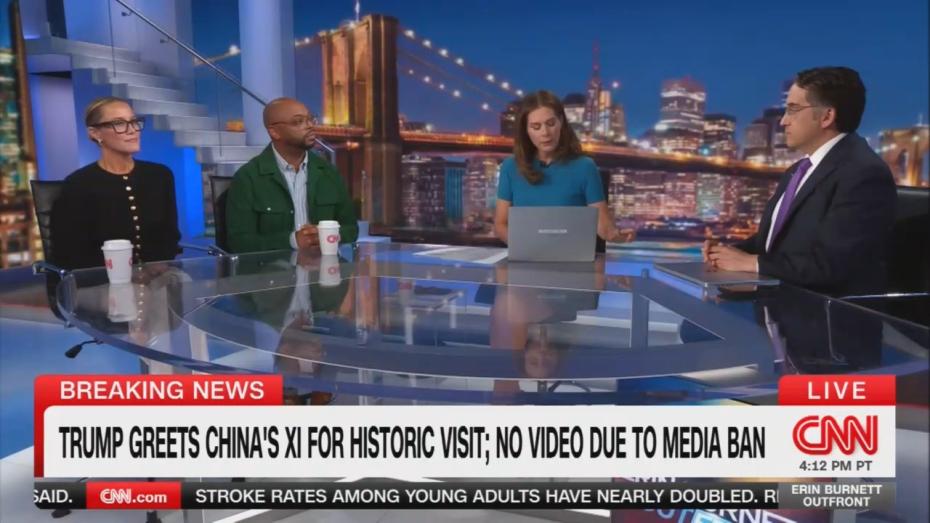
On Wednesday, Erin Burnett’s opening monologue for OutFront began with lamenting CNN’s lack of coverage on China President Xi Jinping’s first White House visit in over 10 years due to the media ban. Burnett reached on how both presidents were alike, and opened discussion for more disparaging comments; she herself in agreement with opinions regarding President Trump’s “dictatorial” nature.
With the lack of coverage on Xi’s White House welcome, Burnett compared how the restriction of CNN, Politico, and MS NOW from White House grounds was, “a ban that is more likely to be seen in Beijing than Washington”:
China's Xi Jinping does have absolute control over the media. He has the power to silence dissenting voices. And that's exactly what Trump is doing on the same day that he meets with Xi, where he is rolling out the red carpet for the Chinese President, something that hasn't been done on U.S. soil. We haven't been here in nearly a decade.
Burnett gave the impression that Trump coveted the power that a dictator held. She did this in her comparison of the two presidents, in which, “the power that Xi Jinping wields over his own press, the ability to silence dissent, imprison people he doesn't like, you know, all of that that he has and Trump does not have.”
Even with White House Deputy Press Secretary Taylor Rogers’ assurance of Trump being, “the most transparent President that our country has ever seen,” with reporters being able to freely enter the Oval Office, Burnett pressed on about Trump’s admiration toward Jinping’s power over the press.
Former Special Counsel at Department of Defense Ryan Goodman chimed in on how no past United States president could compare to what Trump has attempted. Goodman even said that, “There's one scuffle that happens with Obama, but it doesn't end up in court. So that's why we have CNN and Acosta v. Trump, Brian Karem v. Trump, Associated Press v. Trump.”
In complete disregard, Goodman failed to mention how Obama wanted to put Fox News chief correspondent James Rosen in prison back in 2009. And the “scuffle” that happened with Fox News didn’t end up in court because the network chose not to sue, whereas the press in this current issue ran to a judge.
Goodman continued by explaining how Trump is essentially gaining the power of a dictator if he continues to exercise the DOJ’s appeal to the courts (Click “expand”):
He's not only doing it, but he's forcing the issue into the courts in order to say this is the maximalist power that I want. And it's from day one, when people looked at their first executive orders, the claim of executive authority is so maximalist. One set of lawyers called it dictatorial authority because not even after 9/11 did George W. Bush claim this level of maximal executive power. That's what he's trying to do through the courts. He's actually trying to obtain that power through the courts. They are pushing back on it, but that is totally unprecedented, and it is on a spectrum towards something that does not look like American democracy at all.
Burnett commented on the control North Korea holds, and the values Trump believed laudable. CNN Political Commentator S.E. Cupp added, “Trump wishes he were president of a country that looked more like Russia or Hungary or China…he seems to look up to regimes that behave in these oppressive ways, and he's accusing our own people of engaging in that kind of actions and activities…”
Cupp ended her rant with the obvious statement that Americans love the Constitution and weren’t keen on seeing it change.
Former Trump White House Press Secretary Stephanie Grisham closed out the segment with her bewildered claim that Trump studied the behavior of other world dictators in an attempt to make himself more powerful:
I heard him on two different occasions in a bi-lat with China and in a bi-lat with North Korea. The North Korea– I actually physically fought those guards to get the press into that room, and he told them on both occasions, the dictators, that is, that the press aren't they animals, they're animals, they're crazy, you have the right idea.
So, he absolutely wants to have a presidency more on the side of dictators.
All in all, Burnett pushed the idea that Trump wants to use freedom of the press as an avenue to build up his power as a leader, ultimately ruling who and what has the ability to capture the likeness of his administration and how it is presented to the public. A dangerous notion to peddle.
The transcript is below. Click "expand" to read:
CNN Erin Burnett OutFront
September 23, 2026
07:02:00 p.m. Eastern(...)
ERIN BURNETT: Now, when announcing the ban in a post that day, Trump also said, quote, "Media outlets shouldn't be able to constantly write or report fiction and lies when they're covering the president of the United States."
Now, of course, the reality is that for Trump, fiction and lies refers to any story that he doesn't like. And this is a ban that is more likely to be seen in Beijing than Washington.
China's Xi Jinping does have absolute control over the media. He has the power to silence dissenting voices. And that's exactly what Trump is doing on the same day that he meets with Xi, where he is rolling out the red carpet for the Chinese President, something that hasn't been done on U.S. soil. We haven't been here in nearly a decade.
But you won't find pictures and video today of today's pomp and circumstance. It's hard to find it because the biggest news organizations in this country are still refusing to cover the President because of the ban. Sort of like if a tree falls in the forest, did anybody hear it?
(...)
7:12:58 p.m. Eastern
BURNETT: The White House, Ryan, is downplaying-- we're talking about Xi Jinping being here tonight, right, and the fact that that's an important story. And, you know, as Kristen [Holmes] said, we want to cover it. We absolutely do. But, you know, we're banned. So, we're not -- it's not being covered.
The comparison, though, between the power that Xi Jinping wields over his own press, the ability to silence dissent, imprison people he doesn't like, you know, all of that that he has and Trump does not have. The Deputy Press Secretary today for Trump said the comparisons of the two just don't add up. Here it is. Let me play.
[CUT TO VIDEO]
TAYLOR ROGERS, WHITE HOUSE DEPUTY PRESS SECRETARY: There's no comparison. This is the most transparent President that our country has ever seen. Reporters go in and out of the Oval Office almost daily. They cover him all the time. And these outlets still have the opportunity to cover the United-- to cover the President of the United States. It just might not be from the Oval Office.
[END VIDEO CLIP]
BURNETT: Jonathan Swan, by the way, says we know five percent of what goes on in this White House, five percent. So just the most transparent president doesn't -- flies in the face of any kind of reality. But what about the argument that there's no comparison between what Xi Jinping is doing and what Trump is attempting?
RYAN GOODMAN, FORMER SPECIAL COUNSEL AT DEPARTMENT OF DEFENSE: So, there's certainly no comparison between what Trump's attempting and what other modern presidents have ever attempted. There's one scuffle that happens with Obama, but it doesn't end up in court. So that's why we have CNN and Acosta v. Trump, Brian Karem v. Trump, Associated Press v. Trump.
He's not only doing it, but he's forcing the issue into the courts in order to say this is the maximalist power that I want. And it's from day one, when people looked at their first executive orders, the claim of executive authority is so maximalist. One set of lawyers called it dictatorial authority because not even after 9/11 did George W. Bush claim this level of maximal executive power.
That's what he's trying to do through the courts. He's actually trying to obtain that power through the courts. They are pushing back on it, but that is totally unprecedented, and it is on a spectrum towards something that does not look like American democracy at all.
BURNETT: And that spectrum, S.E., where you have on the other extremes places like Russia or China --
S.E. CUPP, CNN POLITICAL COMMENTATOR: Yeah.
BURNETT: -- or even more extreme, North Korea, those are all individuals and systems, you know, about which Trump has expressed great admiration specifically about their control.
CUPP: I think Trump wishes he were president of a country that looked more like Russia or Hungary or China. The irony is, as he's screaming at home about our Democrats running who are socialists and communists, he seems to look up to regimes that behave in these oppressive ways, and he's accusing our own people of engaging in that kind of actions and activities.
That's what he would really want. He really admires that. It's ill-liberal, it's authoritarian, and it's not who we are. And the American people like the part of the Constitution. They like the part that deals with the First Amendment. They support it.
(…)
7:17:12 p.m. Eastern
STEPHANIE GRISHAM, FORMER TRUMP WHITE HOUSE PRESS SECRETARY: And I do want to just follow up really quickly with something that, well, S.E. said too. But speaking of Russia and North Korea and China, I heard him on two different occasions in a bilat with China and in a bilat with North Korea. The North Korea– I actually physically fought those guards to get the press into that room, and he told them on both occasions, the dictators, that is, that the press aren't they animals, they're animals, they're crazy, you have the right idea.
So, he absolutely wants to have a presidency more on the side of dictators.
BURNETT: That's incredible. They're animals, and you have the right idea. Wow.
All right. Sobering finale there, Stephanie, but thank you very much, and thanks to all of you for being with us.