With far-left DSA-backed candidates like Abdul El-Sayed eking out Democratic primary victories in crucial swing states, broadcast journalists have taken on the arduous task of sanitizing the radicals’ reputations ahead of the November midterm elections. The first order of business: striking politically radioactive terms like “socialist” and “far-left” from the broadcast media lexicon, in favor of softer terms like “progressive,” “populist,” and (absurdly) “not formally a socialist.”
SUMMARY OF FINDINGS:
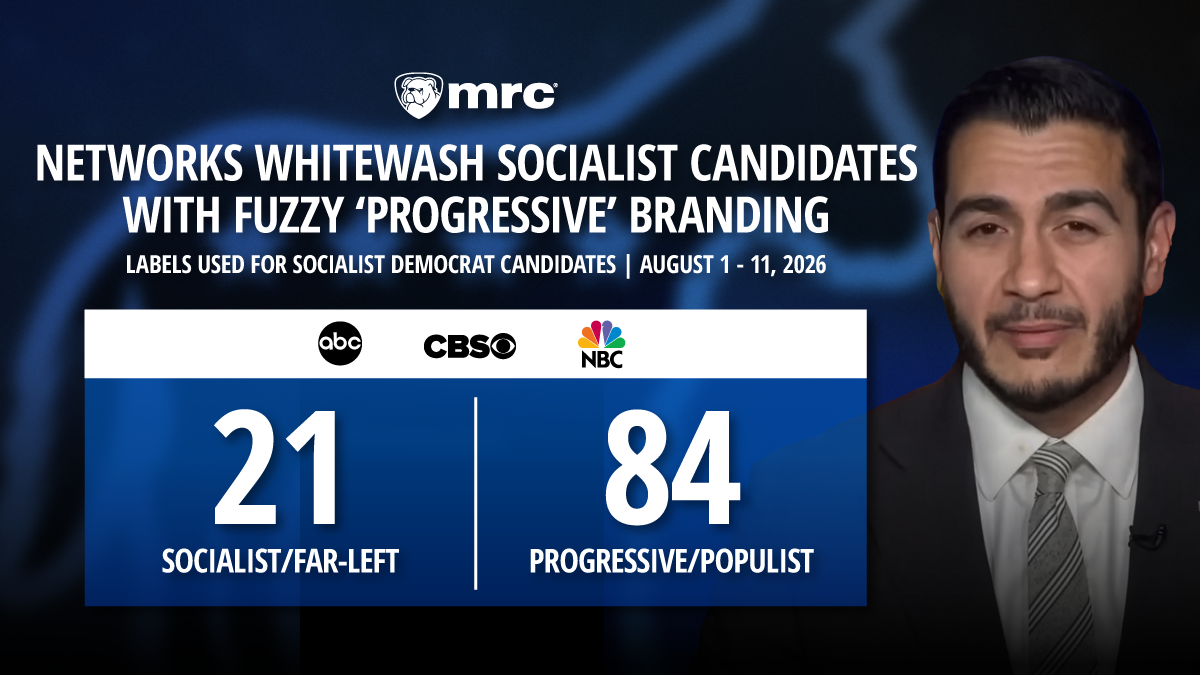
- When discussing radical left-wing candidates, broadcast journalists relied on vague, euphemistic labels like “progressive” 80% of the time.
- Journalists actually denied Abdul El-Sayed’s socialist leanings more often than they acknowledged them.
- Without exception, every Democrat running against a socialist or DSA-backed candidate was described exclusively as “moderate,” "establishment," or both.
MRC analysts examined all midterm coverage on ABC, CBS, and NBC from August 1 through August 11, 2026, including each network’s flagship morning and evening newscasts, as well as their Sunday shows. In 84 instances (80 percent of the time), journalists tagged socialist candidates either merely as “progressive,” or with some even gentler term. There were only 21 instances (20 percent) in which journalists accurately labeled those same candidates as “socialist” or “far-left.”
Michigan Democratic candidate Abdul El-Sayed was by far the largest beneficiary of these political word games. In addition to receiving vocal support from prominent DSA members, El-Sayed often campaigned with self-described socialists like Senator Bernie Sanders (I-VT) and Congresswoman Alexandria Ocasio-Cortez (D-NY), as well as Hasan Piker, a Twitch streamer notorious for routinely encouraging political violence. However, the Michigan hopeful was never officially endorsed by the DSA — nor is he a member — granting both him and his allies in the media just enough wiggle room to lie convincingly about his political convictions.
ABC, CBS, and NBC have magically transformed Abdul El-Sayed from a socialist, to a "progressive," to a populist, to a capitalist -- all in less than two weeks.
They've now claimed he's not a socialist more times than they've admitted he is one. pic.twitter.com/BXM2P6GT7p— Bill D'Agostino (@Banned_Bill) August 12, 2026
On August 2, ABC’s This Week host George Stephanopoulos eagerly reminded viewers that El-Sayed was “not formally a socialist.”
Over the following week, Stephanopoulos’s colleagues went further, uncritically remarking on four separate occasions that the socialist party-backed candidate was, in fact, a “self-described” capitalist. Thus the informal socialist morphed into an avowed champion of capitalism.
The broadcast journalists became so trigger happy with their amorphous political tags that, by the morning of August 12, they’d labeled El-Sayed a capitalist or non-socialist more times (seven) than they’d even acknowledged his ties to other socialist candidates (just five).
Meanwhile, the broadcast networks were most forthcoming in their characterizations of Francesca Hong, the card-carrying DSA member and sworn enemy of Thanksgiving who lost her Wisconsin Gubernatorial primary just hours before this piece’s publication.
Since Hong had publicly branded herself an outright socialist, the broadcast networks could only get so much mileage out of their label makers. As a result ,the journalists correctly slapped her with the socialist tag a still-inadequate 66.7 percent of the time (six times out of nine). Remarkably, NBC still managed to gift her three cheeky “progressive” tags on August 11.
Rather than deploying misleading terminology for Hong, the broadcast journalists instead concluded that the safest move was to avoid mentioning her as much as possible. That strategy, along with her own disastrous optics, resulted in Hong receiving those paltry nine ideological descriptors, as compared to the 70 El-Sayed received during the same period.
Intentionally vague labeling is a time-honored tradition among broadcast journalists hoping to drag a radical Democrat across the finish line. But with just how far leftward the Democrats’ so-called “big tent” has expanded recently, the word games have become more difficult than ever to pull off.