By Brent Bozell | and By Tim Graham | June 30, 2015 | 10:52 PM EDT

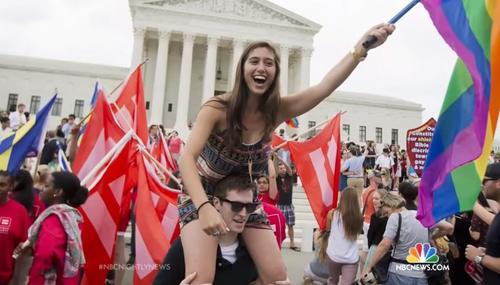
Friday’s gay-marriage mandate from the Supreme Court is merely the latest “landmark” decision on the slippery slope toward obliterating any definition of consensual deviancy. We haven’t defined deviancy down. We’ve shredded it.

Now, it’s social conservatives who have become the focus of fear, violence, and discrimination for maintaining their deeply held religious views that homosexuality is a sin and that “gay marriage” is an act of cultural deconstruction.

By Matthew Balan | June 27, 2015 | 1:07 AM EDT

On Friday, ABC's World News Tonight aired a completely one-sided report on the Supreme Court's ruling that legalized same-sex "marriage" in all 50 states. Terry Moran hyped how Justice Anthony Kennedy "wrote today's landmark opinion describing the stakes in this case in the loftiest terms." Moran failed to include any soundbites from social conservative opponents of the decision, and hyped how "Justice Scalia, in a rage, scorning Kennedy's poetic opinion as little more than a 'fortune cookie.'"

By Curtis Houck | April 28, 2015 | 9:42 PM EDT

All three of the network evening newscasts offered coverage on Tuesday of the Supreme Court’s oral arguments regarding the gay marriage that was proclaimed to be a “landmark case” that was certain to produce “a watershed ruling” on “marriage equality.” On ABC’s World News Tonight, anchor David Muir began the show’s coverage by declaring the “landmark case” will answer whether or not “gay couples have the constitutional right to marry in all 50 states” while using ABC News polling data to tout “a sea change” from a decade ago.

By Tom Blumer | April 22, 2014 | 12:34 PM EDT

In his story (saved here for future reference, fair use and discussion purposes — and in case it gets edited later today; Update: It did) on the Supreme Court's decision this morning upholding Michigan voters' 2006 approval of a ban on race-, ethnic- and gender-based preferences in university admissions, USA Today's Richard Wolf failed to identify the size of the court majority, which was 6-2. Justice Elena Kagan recused herself because she was previously the U.S. solicitor general before being named to the high court. The court's decision effectively upholds such bans in seven other states.

Additionally, by focusing on Justice Anthony Kennedy as "the man to watch," Wolf initially left many readers with the impression that only five justices, Kennedy and the four others usually describe as "conservative" (Roberts, Scalia, Thomas, and Alito) made the ruling. The fact is that they were also joined by Justice Stephen Breyer, one of the supposedly reliable "liberals." Excerpts follow the jump (bolds are mine throughout this post):

By Cal Thomas | March 27, 2014 | 7:10 PM EDT

"Well, then," Jesus said, "give to Caesar what belongs to Caesar, and give to God what belongs to God." (Mark 12:17 Living Paraphrase)

When considering what belongs to Caesar and what belongs to God, what happens when the federal government seeks to replace God by defining "church" and when life begins to have value, the latter having been done in Roe vs. Wade and subsequent court rulings?

By Tom Blumer | November 19, 2013 | 10:18 PM EST

Never one to let facts get in the way of the proabort narrative, Mark Sherman at the Associated Press characterized today's 5-4 decision by the U.S. Supreme Court to allow Texas's abortion law to stand while on appeal as one rendered by "the court's conservative majority."

Really? Anthony Kennedy is one of the justices in the critical "Planned Parenthood v. Casey (1992), which reaffirmed in principle (though without many details) the Roe v. Wade decision recognizing the right to abortion under the Due Process Clause of the Fourteenth Amendment." That's hardly "conservative," though Sherman at least applied the "liberal" label to the four dissenters. Excerpts follow the jump (bolds are mine):

By Paul Wilson | May 8, 2012 | 11:07 AM EDT

Perhaps it’s unrealistic to expect history textbooks to present and analyze events and epochs with complete objectivity. But it’s entirely reasonable to demand that they don’t actively reinforce the news media’s liberal bias when it comes to recent history and individuals who are still alive and active in shaping that history. 

Yet commonly used American history textbooks have eschewed historical analysis when discussing recent Supreme Court justices, and in its place substituted partisan political commentary.

By Noel Sheppard | April 4, 2012 | 12:41 PM EDT

New York Times columnist Maureen Dowd is clearly beside herself over the possiblity the Supreme Court might strike down ObamaCare.

"This court," she wrote Wednesday, "is well on its way to becoming one of the most divisive in modern American history...It is run by hacks dressed up in black robes...[M]irrors the setup on Fox News":

By Ken Shepherd | February 3, 2011 | 3:39 PM EST

"If the majority [of the U.S. Supreme Court] agrees with [Judge Roger] Vinson, President Obama would find not only his health care bill undone, but also face the most significant scaling back of the government's power to use legislation to solve its problems in decades," Time's Michael Lindenberger warned in a February 2 post at the magazine's website.

To reach such a conclusion, however, Lindenberger must have misunderstood Vinson's ruling on Monday in State of Florida v. U.S. Dept. of Health and Human Services, which sought not to "turn back the clock" on commerce clause interpretation but merely prevent its overextension into an unprecedented and dangerous arena: forcing Americans to buy private health insurance under the flimsy illogic that such economic inactivity actually amounts to commercial activity.

"I am required to interpret this law as the Supreme Court presently defines it. Only the Supreme Court can redefine or expand it further," Vinson noted on page 43 of his 78 page opinion. The Reagan appointee noted that no less legislative authorities than the Congressional Research Service and the Congressional Budget Office have found Congress requiring Americans to purchase private health insurance under penalty of law to be "novel" and "unprecedented"

By Colleen Raezler | April 29, 2010 | 4:13 PM EDT
Given the contentious debate over the proper role of religion in American public life, you'd think an important Supreme Court ruling on the issue would be a big story to the network news. But the Court's April 28 finding regarding a cross on a World War I memorial in the Mojave Desert elicited a yawn from CBS's "Evening News," a 78-word report from NBC's "Nightly News," and a one-sided segment from ABC's "World News with Diane Sawyer" that fretted if the Court "move[d] the bar on the separation of church and state."

The cross in question is part of a memorial built in 1934 in the federal-owned Mojave National Preserve to honor fallen WWI veterans. Lower courts ruled the cross unconstitutional and had it covered with a box, despite efforts taken in recent years by Congress to avoid constitutional questions over it by transferring that portion of the Preserve to private owners.

In a 5-4 decision, the Supreme Court ruled this was not a clear-cut violation of the separation of church and state.

"The goal of avoiding governmental endorsement does not require eradication of all religious symbols in the public realm," wrote Justice Anthony Kennedy in the majority opinion. Kennedy noted specifically about this cross that it "evokes far more than religion. It evokes thousands of small crosses in foreign fields marking the graves of Americans who fell in battles, battles whose tragedies are compounded if the fallen are forgotten."

By Ken Shepherd | January 22, 2010 | 3:33 PM EST

A publicly-traded corporation, The Washington Post Company (NYSE: WPO) publishes a daily newspaper which includes daily editorials aimed at influencing public opinion inside the corridors of Congress, White House, and regulatory agencies, and ultimately over voter preferences at the polls.

What's more, the Post Company's newspaper has demonstrated its willingness to devote virtually limitless resources in its efforts to pound out a negative drumbeat in the final days before an election. Just ask former Sen. George Allen (R-Va.) or Gov. Bob McDonnell (R-Va.), two targets of the paper's openly hostile campaigns to derail their candidacies in favor of their endorsed candidates, Sen. Jim Webb (D-Va.) and State Sen. Creigh Deeds (D-Va.) respectively.

Yet when it comes to conservative groups or non-mainstream media for-profit corporation engaging in the same use of "unlimited independent expenditures" to influence voters, that's an entirely different story for the Post, which slammed yesterday's Supreme Court ruling as "Judicial Activism Inc.":

By Matthew Balan | June 29, 2009 | 5:55 PM EDT
Heidi Collins, CNN Anchor; & Jeffrey Toobin, CNN Senior Legal Analyst | NewsBusters.orgOn Monday’s Newsroom program, CNN’s Jeffrey Toobin couldn’t find a consistent argument about the Supreme Court’s ruling in favor of New Haven firefighters who accused their city of reverse discrimination. Toobin first reported that Justice Kennedy, “the swing vote in this case, as in so many others,” wrote the decision, but minutes later, he labeled it as a ruling by “the five conservatives on the Court.”

When news of the Court’s decision broke early in the 10 am Eastern hour of the CNN program, anchor Heidi Collins brought on Toobin, the network’s senior legal analyst, to comment on the five to four ruling. He began with a summary: “The Supreme Court- five to four- in a decision by Justice Anthony Kennedy, who is the swing vote in this case, as in so many others, ruled that the New Haven firefighters were the victims of reverse discrimination.”