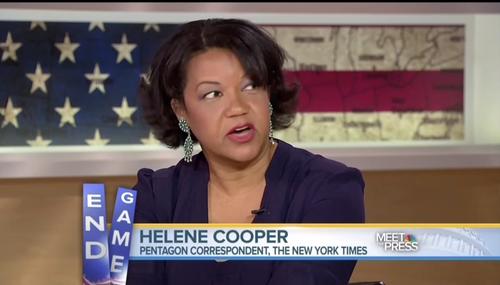
During a panel discussion on Meet the Press, New York Times reporter Helene Cooper rehashed President Obama’s infamous scolding of the Cambridge, Massachusetts police for acting “stupidly,” recalling that at the time Obama's take “made sense to me.”
Henry Louis Gates


The North Korean e-mail hack of Sony continues to haunt Hollywood. The leftist group WikiLeaks recently posted a searchable set of the documents and the London Daily Mail found a new scandal subject: Ben Affleck....and PBS.
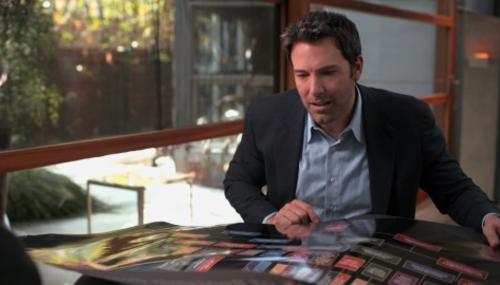
Featured on the show Finding Your Roots, Affleck demanded (and got) the censorship of a slave-holder in his family tree, creating a scandal for the public-broadcasting network. The show that aired in November only honored his mother for her Freedom Rider activism during the black civil rights movement in the Sixties.

It’s funny how hard-earned success can change even a liberal’s view about the greatness of this country. That’s exactly what happened to rapper Nas as he revealed on Friday's Charlie Rose show: “Where I was once a rebel to America...I love America!”
On to promote the new documentary Time is Illmatic the hip-hop star was asked by Rose “Why do you like America a lot more? Because it accepted you?” Nas responded: “No! I don’t want to feel accepted...I want to earn it.” He then continued to express pride in his country: (video after the jump)
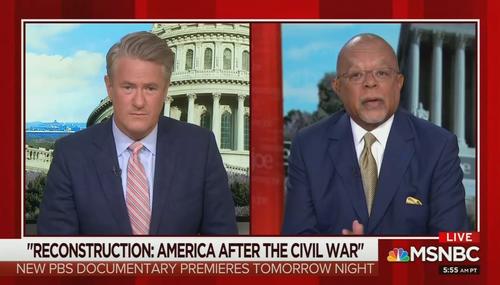
For all his accomplishments, Henry Louis Gates might be doomed to being best remembered as the man whose arrest led to the "Beer Summit." But the Harvard prof had something surprising to say on today's Morning Joe: Gates questioned the need for affirmative action for affluent African-Americans, saying instead such programs should seek to help poor people, regardless of race.
Gates made the personal political, citing the case of his own two daughters, whom Gates described as having a "privileged" life."Do they really need to benefit from affirmative action?", asked Gates rhetorically. View the video after the jump.

PBS has announced its new fall schedule, and it unfolds like a reinforced liberal stereotype. It includes a "landmark" six-hour series on Latino-American history narrated by Benjamin Bratt, and a six-hour series on African-American history narrated by Henry Louis “Beer Summit” Gates, from America's colonial period "up to the present day — when America has a black president yet remains a nation divided by race."
The liberal network will air a “Great Performances” special titled “Barbra Streisand: Back to Brooklyn,” and, of course, to mark the 50th anniversary of the dark day in Dallas when President Kennedy was shot and killed, PBS is planning hours and hours of JFK specials:
"Finding Your Roots with Henry Louis Gates Jr." is another of the Harvard professor's wonderful television series for PBS. This is "must-see TV" and a more than worthy sequel to three previous projects Gates has hosted about how some of us came to be what and who we are.
In this latest 10-part series, Gates explores the genealogical and genetic history of a diverse group of people, from entertainer Harry Connick Jr. and Pastor Rick Warren to former Secretary of State Condoleezza Rice and Brown University President Ruth Simmons. There are less famous people, but the famous get you hooked for the rest.
President Obama's vacation in Martha's Vineyard also became an occasion for a panel of liberal journalists, politicians, and academics to mourn his alleged mistreatment in the media at a race-and-the-media panel discussion organized by Harvard professor Charles Ogletree. PBS Washington Week anchor Gwen Ifill lamented the overwhelming media bias against Obama in the Henry Louis Gates controversy, when Obama said he didn't have all the facts, but the local police "acted stupidly" for their actions in arresting Gates on his own porch.
Ifill somehow ignored that the Obama-supporting news networks pouted over how this comment was a "distraction" from passing ObamaCare, and overpublicized the "beer summit" Obama held at the White House with Gates and his arresting police officer to fix any public-relations damage he might have incurred. (She even ignored the newscast she sometimes anchors, the PBS NewsHour.) On August 18, the Vineyard Gazette reported Ifill complained:

It's not just members of the media standing up to support disgraced journalist Helen Thomas after her unscheduled retirement caused by anti-Semitic remarks she made on camera last week.
The rabbi that caught her disgusting comments on videotape and put them on the Internet has received 25,000 hate-email messages - and counting.
Hours after MSNBC's Keith Olbermann actually called Rabbi David Nesenoff one of his "Worst Persons in the World," CBS-TV in New York reported the vicious electronic attacks streaming into the rabbi's inbox like a "ticker tape" (video follows with partial transcript, h/t HotAirPundit):
Harvard Professor Henry Louis Gates appeared on Friday’s Good Morning America to promote a new series on genealogy and revealed to George Stephanopoulos that he might be related to Hillary Clinton. Gates told the former Democratic staffer turned journalist, "You are very likely a maternal cousin with Hillary Clinton."[Audio available here.]
Gates, who very famously was involved in an altercation with the Cambridge police in 2009, recounted how Stephanopoulos (to promote the GMA segment) submitted a swab sample for the DNA company 23andMe: "According to 23andMe, George, you most likely share an ancestor with a very prominent American woman, a person who, like your haplotype, is an intrepid traveler yourself."
Some of the mainstream media intelligentsia following the Fort Hood, Texas massacre have cautioned people to reserve judgment about the suspect Major Nidal Malik Hasan and have bypassed many key details in order to live up to what could be construed as a politically correct standard. CNN's Lou Dobbs isn't one of them.
Dobbs, on his Nov. 10 radio program, didn't reserve judgment and criticized President Barack Obama for telling people to do so in a speech following the tragic event. Dobbs played a clip from the speech Obama gave last week in which he warned, "We don't know all the answers yet and I would caution against jumping to conclusions until we have all the facts."
"Isn't that remarkable, telling the American people not to jump to any conclusions?" Dobbs said. "Not to speculate, not to be curious about what is happening to our men and women, who should be the center of all of our attention and concern and care. Let's compare that statement by our president to what he said at the end of a press conference about health care shortly after the arrest of Professor Henry Louis Gates, his good friend."
Exactly one week after the highly-publicized arrest of Harvard professor Henry Louis Gates stirred a national discussion on race relations, legendary singer-songwriter Bob Dylan was detained by police officers in a "low-income, predominantly minority neighborhood" in Long Branch, New Jersey.
Makes one wonder why it took so long for this to get reported, and if news outlets that were convinced Gates's arrest was racially motivated will see the delicious irony in a white rock star being questioned by police just because he was "wandering around the neighborhood."
The Associated Press sure didn't (h/t Clarence Page):
In Frank Rich's Sunday column for the New York Times, "Small Beer, Big Hangover," Rich drained the last dregs out of the White House beer summit, involving the president, Harvard professor Henry Louis Gates, and Cambridge Police Sgt. James Crowley, but not before using it to launch his grand unified field theory of the re-emergence of racism among conservatives in the wake of Obama's victory. Deploying his usual melodramatic flair (Rich was once the paper's theatre critic), Rich wrapped the Gates arrest controversy together with the Birther brigade, and tied on other events with the slightest hint of skin-color content, like Judge Sonia Sotomayor's impending Supreme Court confirmation.The White House get-together took place to quell an outcry after Obama, during a national press conference, said the Cambridge police had acted "stupidly" in arresting Gates.
The comforting thing about each "national conversation on race" is that the "teachable moment" passes before any serious conversation can get going.