As Lefty Media Embrace 70% Top Tax Idea, Greenspan Calls It ‘Terrible'
Business
January 8th, 2019 1:03 PM
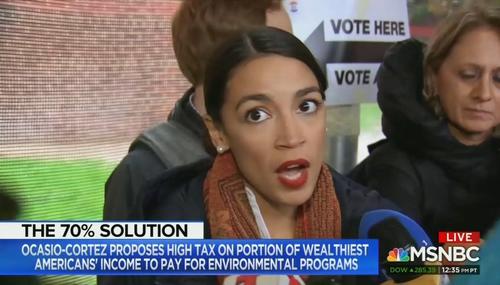
Freshman Rep. Alexandria Ocasio-Cortez, D-N.Y., has many policy ambitions, among them she floated the idea of hiking the top tax rate to a whopping 70 percent to pay for a “Green New Deal.”
Although a chorus of media liberals defended and even applauded the socialist’s “soak the rich” suggestion, some high-profile economists opposed it because it would harm the economy. A CNBC reporter also…
Greenspan: ‘Government Intervention Has Been So Horrendous' Business
December 8th, 2013 11:42 AM
Former Federal Reserve Chairman Alan Greenspan made some rather ominous economic observations Sunday.
Appearing on CNN’s Fareed Zakaria GPS, Greenspan said, “[T]he level of uncertainty about the very long-term future is far greater than at any time I particularly remember.” He blamed it on “government intervention [that] has been so horrendous that businesses cannot basically decide what to…
NB Interview: Peter Schiff on Media and the Economy, OWS
December 1st, 2011 11:39 PM
For conservatives, one of the bright spots of the Occupy Wall Street protests was when millionaire investor Peter Schiff went down to Zuccotti Park with video camera and a sign reading "I Am The 1% - Let's Talk."
On Tuesday, I had the pleasure of speaking with Schiff by telephone in a sweeping interview about his experience at OWS, how the financial media are doing, and ending with his rather…

Krugman Accuses Republicans of Preventing Bernanke from Saving Economy
August 26th, 2011 11:21 AM
It often amazes that liberals in this country revere New York Times columnist Paul Krugman as being an expert economist.
Take for example Friday's intellectually challenged piece entitled "Bernanke's Perry Problem" in which the Nobel laureate accused prominent Republicans such as the Texas governor and Wisconsin Congressman Paul Ryan of preventing the Federal Reserve chairman from enacting…
Greenspan on Meet the Press: No Chance of Default. Really
August 8th, 2011 1:36 AM
We've just spent the past month or so having politicians and the press tell us that if there was no debt-ceiling deal by August 2, the government might default on its debts (of course, Tim Geithner and Barack Obama could indeed have strategically defaulted if they had wished, but work with me here).
But Sunday on Meet the Press, in a remark I expect will not be relayed much if at all by the…

David Gregory Invokes Walter Mondale To Push For Higher Taxes - With H
April 17th, 2011 10:19 PM
As NewsBusters has been reporting, the media have been on a full-court press in recent days supporting the President's push to raise taxes.
Doing his part was NBC's David Gregory who trotted out the words of former Vice President Walter Mondale on Sunday's "Meet the Press" to really drive home the point, and then got a huge assist from former Federal Reserve Chairman Alan Greenspan (video…

E.J. Dionne: 'Tax Cuts Add to the Deficit No Less Than Spending Increa
January 3rd, 2011 9:51 AM
What kind of an idiot must you be to believe that tax cuts have an equal dollar for dollar negative impact on a government budget as spending increases do?
The most obvious answer given the charge of this website is a liberal media member, and the Washington Post's E.J. Dionne nicely proved this point with his column Monday:
Meet the Press: Dick Armey Slams Alan Greenspan's View of Bush Tax Cut
August 22nd, 2010 6:04 PM
David Gregory on Sunday finally got an answer to his question about extending the Bush tax cuts, but it certainly wasn't what he was expecting.For those that have been watching "Meet the Press" this month, the host has been grilling his conservative guests about this issue ever since former Federal Reserve Chairman Alan Greenspan told him on August 1 that tax cuts don't pay for themselves.Having…
CNN's Cafferty: Obama's 'Serious Disconnect' on Jobs and Spending
June 18th, 2010 6:51 PM
On Friday's Situation Room, CNN's Jack Cafferty tossed cold water on the Obama administration's "recovery summer" claims, stating that the "current recovery has been one of the worst for job creation ever." Cafferty also criticized the dangerous growth in the national debt, underlining that there "appears to be a rather serious disconnect," as the President requested billions in additional…
Media Neglect: Populist Rage Aimed at Wall Street as Democrat-Controll
April 28th, 2010 1:19 PM
As congressional Democrats press on with their attempts to get financial legislation reform passed, a key component has been lacking from the debate: how to handle the government-sponsored enterprises Fannie Mae (NYSE:FNM) and Freddie Mac (NYSE:FRE). Although some Republican lawmakers have cried foul over the fact nothing has been included in a bill sponsored by Senate Banking Committee…
Orman Blasts Greenspan for 2004 Mortgage Remarks; Still Blames Banks f
April 8th, 2010 4:13 PM
Everyone is still looking for a scapegoat for the financial crisis that precipitated the current economic malaise. And one of the popular targets has been former Federal Reserve Chairman Alan Greenspan. Greenspan recently testified on Capitol Hill and was pressed about how he may have contributed to the financial crisis. According to Suze Orman, host of CNBC's "The Suze Orman Show," some of…
Tapper Sees ‘Indictment of Ayn Rand’ and Her Faith in ‘Laissez-F
April 4th, 2010 3:08 PM
Invoking the name of objectivist/libertarian writer-philosopher Ayn Rand, hardly a common citation in television news, ABC’s Jake Tapper, on Sunday’s This Week, confronted former Federal Reserve Chairman Alan Greenspan with how he recognized a “flaw” in his perspective as he had conceded “markets cannot necessarily be trusted to completely police themselves.” Tapper wondered:But isn't it more…
Fareed Zakaria: Bush Tax Cuts Are Largest Cause Of Budget Deficit
February 14th, 2010 8:40 PM
CNN's Fareed Zakaria on Sunday demonstrated just how ignorant most media members are of how the federal budget works.During the most recent installment of "Fareed Zakaria GPS," the host actually said, "[T]he Bush tax cuts are the single largest part of the black hole that is the federal budget deficit."Before we examine the staggering stupidity on display here, let's first look at exactly what…
Gregory Asks Greenspan: Bad Idea to Let Bush Tax Cuts Expire
February 7th, 2010 1:10 PM
A rather shocking thing happened on Sunday's "Meet the Press": host David Gregory asked Alan Greenspan and Henry Paulson if it would be a mistake to let the Bush tax cuts expire.Chatting with the former Federal Reserve Chairman and former Treasury Secretary, Gregory referenced Tuesday's Wall Street Journal article about what the impact of allowing these tax cuts to expire would be on the budget…