By Jeff Poor | July 9, 2010 | 2:24 PM EDT

While some on the left side of the aisle in Congress are getting all starry-eyed about prospects of more federal stimulus spending, the first round of stimulus under President Barack Obama may have done even less to help the ailing economy than supporters claim.

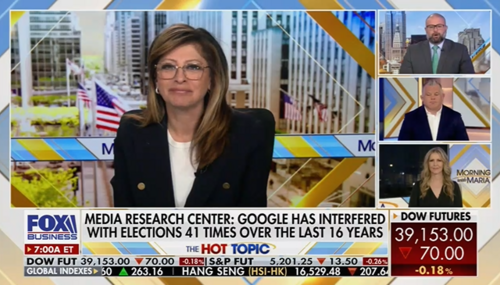
On MSNBC's July 9 broadcast of "The Daily Rundown," co-hosts Chuck Todd and Savannah Guthrie interviewed CNBC "Closing Bell" anchor Maria Bartiromo from the Aspen Ideas Festival in Aspen, Colo. And Bartiromo offered her views why the economy didn't spiral out of control any more than it did. She said according to some on Wall Street, it wasn't Obama's $787-billion "stimulus" that included a huge bulk of state government bailout spending, but instead action by the Federal Reserve to put more liquidity in the economy.

"Look, there's no doubt about it - we were close to going off a cliff the weekend at Lehman Brothers declared bankruptcy, Merrill [Lynch] was sold and AIG acquired by government," Bartiromo said. "You know, I mean I think we were very close and the economy needed stimulus in a big way. It's arguable whether that stimulus that helped the economy was really because of the stimulus plan or really because of the Federal Reserve. I think most people on Wall Street will believe and will tell you that it was really the Fed action in terms of giving greater access to the banks to overnight lending that really, really got us out."

By Jeff Poor | May 21, 2010 | 12:27 AM EDT

With the Dow Jones Industrial Average (DJIA) taking another tumble of 376 points on May 20, some investors are pointing to problems in Europe for the sell-off. However, there may be problems at home as well.

CNBC's CME Group floor reporter Rick Santelli explained on the May 20 broadcast of "Closing Bell" it had a lot to do with the Europe and the Euro, however it isn't all coming from abroad.

"Well, a couple of things," Santelli said. Well, first of all, if you look at the high-grades, they widened out with the high-yields widened out more today at levels today that are wider than the day of the flash crash. That's ‘a.' And ‘b,' you know Maria, we have a 1.2511 on the Euro. This is so much more than just focusing on the Euro."

By Geoffrey Dickens | May 7, 2010 | 10:16 AM EDT

When was the last time any one used a typewriter? Well on Friday's Today show, in talking with CNBC's Jim Cramer and Maria Bartiromo, in what has to be a classic out of touch moment, Lauer flashed back to the '70s when he asked if yesterday's market drop was caused by someone hitting the "wrong key on a typewriter." Later on, after perhaps being informed by his producer that no one is using an IBM Selectric any more, Lauer used the more updated terminology of "keyboard." [video below the fold] [audio available here]

The following exchange was aired on the May 7 Today show:

By Noel Sheppard | May 6, 2010 | 8:49 PM EDT

The man who predicted the bursting of the housing bubble as well as 2008's economic collapse says that what happened in the markets around the world today is just the next stage in the financial crisis.

"The first stage was this massive re-leveraging of the private sector that led to the financial crisis and which has responded now with a massive re-leveraging of public sectors with budget deficits of the order of 10 percent," Nouriel Roubini aka Dr. Doom told CNBC's Maria Bartiromo.

"So I think that the markets are realizing that we have socialized a lot of the private losses with unsustainable fiscal deficits."

He believes the bond markets in parts of Europe seriously began realizing the depth of the problem today cautioning, "And soon enough they're going to wake up in the United States" (video follows with partial transcript and commentary):  

By Jeff Poor | May 6, 2010 | 5:57 PM EDT

While everyone is scratching their heads and trying to figure out how the Dow Jones Industrial Average (DJIA) lost nearly 1,000 points before rallying back to lose only 347 points - it appears not to be limited to just one stock.

On CNBC's May 6 "Closing Bell," correspondent Matt Nesto explained that investigators for both the stock exchanges and for Citigroup, the firm that some are pointing fingers at for a so-called trader error, have narrowed it down to a futures index called the E-mini S&P 500.

"A person familiar with the Citi investigation said one focus of the trading probes were the futures contracts tied to the S&P 500 stock index known as the E-mini S&P 500 futures and in particular that two-minute window in which 16 billion of the futures were sold," Nesto said. "Again, those sources are telling us that Citigroup's total E-mini volume for the entire day was only 9 billion, suggesting that the origin of the trades was elsewhere."

By Jeff Poor | April 5, 2010 | 5:05 PM EDT

With summer driving season upon us, it's important to note that there's a traditional jump in gas prices. But will this seasonal adjustment benefit commodities, specifically oil and make the price of gasoline even higher? That could happen if those forms of energy lure investment from what seems to be an over-valued equities market, brought on by what some claim is cheap money. 

On her April 5 program, "Closing Bell" host Maria Bartiromo asked CNBC's CME Group floor reporter Rick Santelli if a move higher in commodities was due to inflation. However, according to Santelli, it's not inflation but a move by investors out of a potentially over-valued equities market that will cause a rise in commodities.

"Well, you know, I don't like to link the two together," Santelli said. "I mean, many times you know, it is core [minus] food and energy. So I think throw all that away. I think the better question is, is that when people are afraid to put their money to work in treasuries, because rates may be going higher, maybe afraid that we are a little long in the tooth in the sugar-buzz rally of equities - boy, commodities is the place to be. Most of the good dollar trades probably already out there."

By Jeff Poor | April 1, 2010 | 5:42 PM EDT

Green jobs to save the American economy?  If you have listened to the various politicos on the left end of the spectrum, especially before and after the passage of the $787-billion stimulus package earlier, you would think that is the cure-all.

But so far it isn't working and there are other fundamental problems that lie ahead according to some energy market analysts, like much higher oil prices - despite the pledge by President Barack Obama to open up 160 million acres for future oil exploration and drilling. To avoid the price of $100-plus oil, CNBC's CME Group floor reporter suggested expediting the process, as was the case with ObamaCare and TARP.

"I think what you're hitting on is so important because the President of course talking about some of these jobs, but also talking about drilling," Santelli said on CNBC's April 1 broadcast of "Closing Bell." "You know, if the government was able to put forth health care and the government was able to do bailouts and TARP and stretch the rules, if they wanted to get jobs now and avoid the $100-plus oil you know that's coming they could drill quickly if they wanted to. And this is something that needs to be discussed, don't you think?"

By Anthony Kang | March 22, 2010 | 8:59 PM EDT
Former presidential candidate and New York City mayor Rudy Giuliani minced no words when it came to the Obama administration's massive health care overhaul. In an exclusive interview with CNBC's Maria Bartiromo, Giuliani stated that, plain and simple, it "was an ideological act by the Congress" liberal Democrats "are very happy about."  

"Instead of privatizing - which is what our government should be doing - we're taking major roles of the economy for the United States government," Giuliani told "Closing Bell" anchor Bartiromo. "And it is not an exaggeration to say we are starting to look more like a European social democracy than we are an American free-market capitalist society."

A self-avowed free-market advocate, Bartiromo attempted to defend the Democrats' actions for a second: "Let me take devil's advocate for a minute here and say, ‘Okay, you say socialism and we're seeing this government takeover. Well maybe some of this stuff wasn't working before, so how do we know this isn't going to work better?'" she posed.  

Giuliani lamented how disingenuous Obama's entire argument about a health care "crisis" was, seeing as how much of the significant provisions do not go into effect for years - and quite possibly under the watch of a Republican president.

By Brad Wilmouth | February 12, 2010 | 1:09 PM EST

On Thursday's Morning Joe on MSNBC, CNBC's Maria Bartiromo appeared as a guest and recounted some of President Obama's anti-business, anti-wealthy stands as she informed host Joe Scarborough and the panel why some see Obama as anti-business despite his support of bailouts on Wall Street. Responding to Scarborough's declaration that "there has been a redistribution of wealth since Barack Obama has ... been President, it’s the largest redistribution of wealth in the history of mankind, but it’s gone from main street to Wall Street. If I were a Wall Street banker, I’d love this guy," Bartiromo responded:

No, I mean, I don’t see it that way. ... I think that at the end of the day, there has been a feeling out there that he’s anti-business, that there are higher taxes on business and they’re coming, even higher taxes are coming on business and on the wealthiest individuals and the highest earners, so that hasn’t changed.

After Scarborough persisted, Bartimoro added:

By Jeff Poor | January 21, 2010 | 8:30 AM EST

When you breach the sacrosanct wall between church and state, and use religion to promote policy, bad things happen. At least, that's what the left has been telling us for years.

But Rev. Jim Wallis, editor-in-chief of Sojourners magazine and author of "Rediscovering Values: On Wall Street, Main Street and Your Street," sees it differently. Wallis used his interpretation of religion, particularly the Bible, to play the populist card and categorize portions of the American private sector as greedy on MSNBC's Jan. 21 "Morning Joe."

"These bank bonuses, I would say, are a sin of Biblical proportions," Wallis said. "But to pick on the banks alone misses the point. It's a symptom, I think of a real erosion of societal values because new maxims have taken us over - ‘greed is good,' ‘it's all about me and I want it now.'"

By Jeff Poor | November 3, 2009 | 9:15 AM EST

There's a lot of uncertainty with the U.S. economy and a lot of its recovery hinges on some key policy decisions due from the federal government. 

On CNBC's Nov. 2 "The Kudlow Report," CNBC host Maria Bartiromo discussed her interview with former Chairman of the Federal Reserve and Obama adviser Paul Volcker from the Global Financial Leadership Conference in Naples, Fla. One of the topics Bartiromo reported on from the conference was the possibility the Bush tax cuts would be allowed to expire, which she insisted is unlikely.

By Jeff Poor | July 27, 2009 | 2:23 PM EDT

At least one journalist isn't impressed by the health care initiatives of  the White House and congressional Democrats, and is warning of consequences should they succeed.

CNBC's Maria Bartiromo was on MSNBC's July 27 "Morning Joe" to preview her upcoming special "Meeting of the Minds: The Future of Health Care," set to debut on July 27. According to the Bartiromo, who also anchors "Closing Bell" and "Wall Street Journal Report with Maria Bartiromo," much of the increased costs of health care could be prevented with changes in lifestyle and behavior.

"You know, I mean the issue is - 70 percent of the cost of health care is preventable disease. It's lifestyle, behavior," Bartiromo said.