The 2016 Debates: How the Media Hailed Hillary and Trashed Trump
September 8th, 2024 10:10 AM
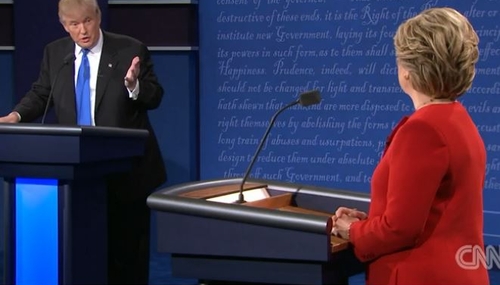
Using the media's coverage of Donald Trump’s three debates with former Secretary of State Hillary Clinton in 2016 as a guide, expect the press on Tuesday night to adore Kamala Harris’s performance, while deriding Trump as someone out of a “third world” “banana republic.”
NewsBusters Podcast: Reporters Admit They Stunk on Biden's Age Problem
July 3rd, 2024 10:36 PM
CNN media reporter Hadas Gold found some less-than-courageous journalists to admit (anonymously) that they could have done a much better job of reporting on President Biden's cognitive decline before the disastrous debate. But they worried about the "blowback" from Team Biden and from the "liberal Twittersphere."
Video
BIZARRO WORLD: Jill Abramson Thinks NY Times Full of ‘Centrists’
July 16th, 2020 5:00 PM
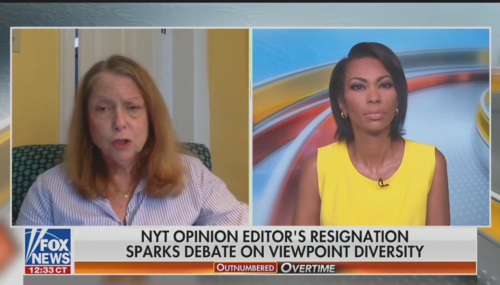
Former NYT executive editor Jill Abramson discusses with FNC's Harris Faulkner the resignation of New York Times columnist Bari Weiss, who in her resignation letter described constant bullying by NYT colleagues opposed to her centrist views. Abramson denies that the Times is edited by "a cabal of left-wing journalists." Abramson claims that most of the columnists at the Times are "centrists…
Video
Former NYT Editor Struggles to Cover for Wretched Kavanaugh Story
September 20th, 2019 11:14 AM
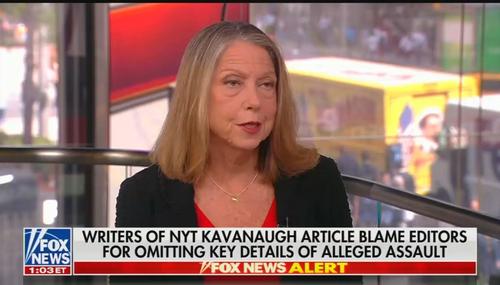
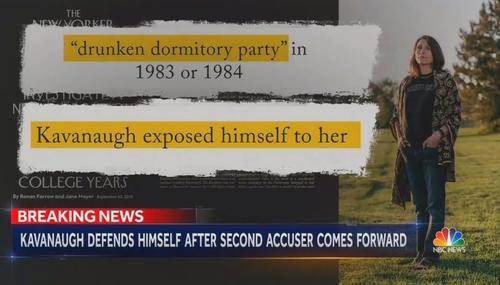
As The New York Times goes into damage control mode following their erroneous Justice Kavanagh hit piece, former Times executive editor Jill Abramson appeared on Fox’s Outnumbered Overtime on Wednesday in an attempt to excuse the paper for leaving key exculpatory evidence out of the initial article. Abramson tried to claim "no one has challenged the basic accuracy of the story that they…
Video
Former NY Times Top Editor Fights with Fox About Paper's Racism Hype
August 21st, 2019 3:22 PM
Former New York Times executive editor Jill Abramson appeared on the Fox News program America's Newsroom on Wednesday morning to defend the Times after angry staffers leaked a transcript of an internal "town hall" meeting that executive editor Dean Baquet had with employees. Abramson was effusive over how Baquet's position was perfect, that he spoke out for independent journalism that holds…
Video
Former NYT Editor Jill Abramson Accused of Plagiarism
February 7th, 2019 4:02 PM
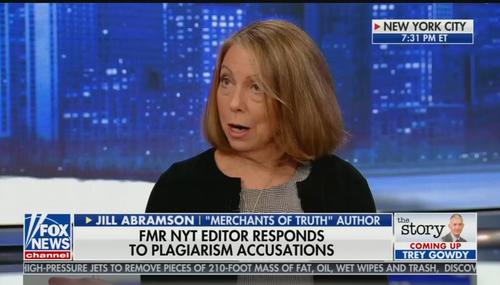
Former New York Times executive editor Jill Abramson has been hit with plagiarism accusations in the wake of her just-released book. Michael Moynihan of Vice on Wednesday tweeted several passages from Merchants of Truth: The Business of News and the Fight for Facts, finding passages that were very similar to previously published articles.
Video
Ex-NYT Editor Ticks Off Joy Behar for Admitting Paper Is Anti-Trump
February 6th, 2019 3:06 PM
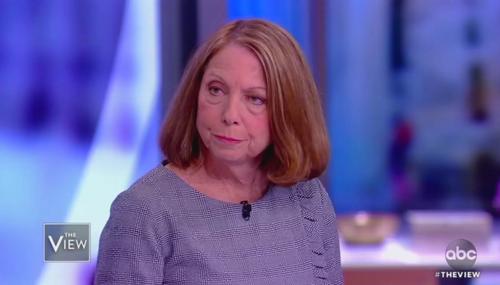
Former executive editor for the New York Times Jill Abramson created headlines last month when she admitted that her former paper has become “unmistakably anti-Trump.” She appeared on The View Wednesday to talk about this very topic, detailed in her new book, “Merchants of Truth.” But co-host Joy Behar was visibly peeved that Abramson was out speaking about the Times in an unfavorable way and…
NYT's Bruni Warns Press: Don’t Let Trump Fool Us Again in 2020
January 13th, 2019 5:00 PM
On the front of the New York Times Sunday Review, Frank Bruni warned his media colleagues not to fall for the old fairness ploy when it came to helping the Democrats defeat Donald Trump in 2020: “Will the Media Be Trump’s Accomplice Again” -- We have a second chance in 2020. Let’s not blow it.” Bruni more or less argued (as his colleague Jim Rutenberg had done in August 2016 on the front page)…
Video
Ex-NY Times Editor Rips Her Own Paper As 'Raw Opinion' Against Trump
January 2nd, 2019 2:03 PM
Fox News media analyst Howard Kurtz reported Wednesday that former New York Times executive editor Jill Abramson offers an "extraordinary rebuke" of her former newspaper in a new book. Abramson, who led the Times from 2011 to 2014, called out current executive editor Dean Baquet: "His news pages were unmistakably anti-Trump...the more anti-Trump the Times was perceived to be, the more it was…
NYT Opinions Cite Phony ‘Corroborating Evidence’ on Kavanaugh
September 28th, 2018 6:40 PM
The New York Times editorial page on Friday joined the paper's news pages in criticizing Brett Kavanaugh’s “angry” tone in defending himself against uncorroborated assault allegations during his Senate Judiciary Committee testimony on Thursday. And former executive editor Jill Abramson doesn't seem to know what “corroborating evidence" means.
Bozell & Graham Column: The Vast Anti-Kavanaugh Conspiracy
September 25th, 2018 11:14 PM
Washington Post media reporter Paul Farhi wrote a September 25 article on liberal media bias headlined “Kavanaugh supporters see a conspiracy afoot.” The Post painted this as a little crazy, like a UFO was involved. Can anyone imagine the idea of the Democrats and liberal reporters working hand in glove to torpedo a Republican nomination? Yes, we've seen it over and over again.
Video
Abramson: GOP Strategy -- 'Destroying' Kavanaugh Accuser If Necessary
September 18th, 2018 9:26 AM
Introducing Jill Abramson on CNN this morning, Alisyn Camerota said, "you say that you shudder to think what will happen" when Christine Ford is questioned at Monday's scheduled Senate hearing. Replied Abramson: "I think that the Republicans, despite all the changes that have happened in the generations since those [Clarence Thomas] hearings, are still going to go in with a strategy to save this…
In WashPost, Ex-NYT Editor Calls Bob Woodward 'Truth's Gold Standard'
September 9th, 2018 10:12 PM
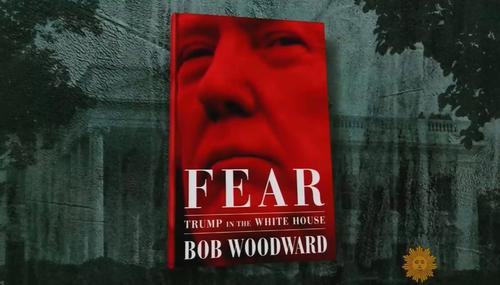
The Washington Post published a long advertisement for Bob Woodward's new book Fear on Sunday. Well, to be more precise, the Post printed a book review by former New York Times executive editor Jill Abramson that sounded like an advertisement. It won't be surprising to see Abramson making the book's cover in later printings with her praise: "Woodward is truth's gold standard."
NY Times Gives Reporter a ‘Fresh Start’ After ‘Unacceptable’ Romances
July 3rd, 2018 10:23 PM
After an extensive internal review, The New York Times announced on Tuesday that Ali Watkins would receive a “fresh start” and move from Washington, D.C., to “a new beat” in New York City even though the 26-year-old reporter had been romantically involved with at least two potential sources over a three-year period. Executive Editor Dean Baquet explained the decision by stating the Times “must be…