By Tom Blumer | December 8, 2014 | 2:41 PM EST

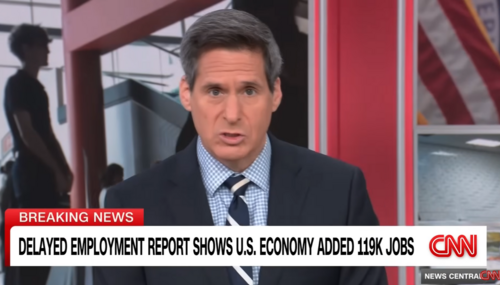
Friday's Employment Situation Summary contained one strong element: In November, the economy added 321,000 seasonally adjusted payroll jobs. That's not insignificant, but that news, especially in the report's full context, certainly didn't justify the level of elation seen in much of the press.

Predictably, the Associated Press found a specious reason to characterize the government's report as signifying a "turning point." Get a load of why: "For the first time since the Great Recession ended 5-1/2 years ago, America's unemployed are now as likely to be hired as to stop looking for a job." In other words, for the first time in 65 months, what people would expect to be a normal situation finally occurred.

By Tom Blumer | November 28, 2014 | 10:51 AM EST

Sometimes, one has to remember that op-ed writers don't always get to pick their headlines, though I would hope that they're allowed to register their objections. So it's not clear that Los Angeles Times guest blogger Joel Silberman is responsible for the headline at his Monday blog post about how, or even whether, to deal with relatives who disagree with you politically on Thanksgiving.

But Silberman's resume indicates that he would probably have been comfortable with the headline used: "What to do if your crazy right-wing uncle comes for Thanksgiving." Excerpts and some background on Silberman follow the jump (bolds and numbered tags are mine; links in final two excerpted paragraphs are in original):

By Tom Blumer | November 25, 2014 | 11:33 PM EST

An Associated Press story late this afternoon has New York Senator Chuck Schumer saying the darnedest things, with only a tiny bit of pushback from reporter Charles Babington.

In the wake of a midterm election rout which saw Republicans win at least eight Senate seats, increase their House majority, and take gubernatorial races in at least three deep blue states (MD, MA, and IL), Schumer now says that Democrats erred in pushing passage of the Affordable Care act, aka Obamacare, at the supposed expense of economic issues. Hey Chuck, that's because the Keynesian clowns in the Obama administration thought they had the economy totally under control in 2009 thanks to the stimulus plan.

By Tom Blumer | November 25, 2014 | 7:10 PM EST

After reading Elaine Kurtenbach's coverage of how Japan's latest dive into yet another recession is affecting young people there, I can only say, "The Keynesian koolaid is strong in this one."

The AP reporter's headline says that the recession was "unexpected," and her first sentence calls it "a surprise." Anyone watching economic events in the country, and I think that's supposed to include her, should have known it was imminent. Kurtenbach, and apparently every other Keynesian koolaid drinker is shocked — shocked, I tell you! — that the recession occurred despite "unprecedented stimulus," and believes that young Japanese really, really want yet another tax increase (bolds and numbered tags are mine):

By Tom Blumer | November 20, 2014 | 10:03 AM EST

Boy, it's a good thing that the unemployment benefits Congress continued to extend during most of the first five-plus years of Barack Obama's presidency didn't hurt the economy much.

A study commissioned by the Cleveland branch of the Federal Reserve concluded that extended benefits "only account for a fraction of the actual increase in the unemployment rate." The allegedly minimal impact of that "fraction" follows the jump.

By Tom Blumer | November 18, 2014 | 11:41 PM EST

There were several more of those infamous "U-word" ("unexpectedly") sightings yesterday in the business press, as Japan — to the surprise of no one who has successfully avoided the Keynesian koolaid — reported that its economy shrank for the second quarter in a row, officially falling into yet another recession.

The U-word hit the trifecta, appearing in reports at the Associated Press, Bloomberg and Reuters.

By Tom Blumer | October 18, 2014 | 11:04 PM EDT

On October 8, Andrew Taylor at the Associated Press wrote that "(President Barack) Obama inherited a trillion-dollar-plus deficit after the 2008 financial crisis." In a NewsBusters post later that day, I pegged Obama's true inheritance at roughly $245 billion as of when he was first sworn into office, and at about $600 billion if projected over the full fiscal year. The actual deficit for fiscal 2009 came in at just over $1.4 trillion due to deficit-increasing actions by Obama and the Democrat-dominated Congress.

I guess we're supposed to forget about Taylor's egregious falsehood, because AP's national site has since replaced his story, perhaps more than one time. That's not happening.

By Tom Blumer | October 8, 2014 | 2:44 PM EDT

In a sign that the historical revisionists and Barack Obama legacy builders at the Associated Press, aka the Administration's Press, may have shifted their operation into high gear for the final weeks of the midterm election campaign, Andrew Taylor has written that "Obama inherited a trillion-dollar-plus deficit after the 2008 financial crisis."

The occasion for Taylor's tripe is the Congressional Budget Office's release of its final Monthly Budget Review for fiscal year 2014. In the report, which the AP has almost always ignored in every other month in favor of waiting for the official Monthly Treasury Statement issued shortly thereafter, the CBO estimates that the year's budget deficit will come in at "only" $486 billion. A grab of Taylor's original full five-paragraph blurb, which has since been revised while still containing the "inherited" claim, follows the jump:

By Tom Blumer | September 18, 2014 | 5:33 PM EDT

The Census Bureau reported earlier today that seasonally adjusted housing starts and homebuilding permits fell by 14.4 percent and 5.6 percent, respectively, in August. The detail wasn't any better, as the two categories within each statistic — single-family and multiple-dwelling homes — also fell.

You can tell that the news wasn't seen as good at the Associated Press, because Josh Boak's related dispatch had already fallen to number nine in the list of the wire service's top ten business stories by 3:30 p.m. The headline and content at Boak's report tried to convince readers that apartment-building volatility was almost entirely to blame, and that things are all right in single-family homebuilding. As will be seen, nothing could be further from the truth.

By Tom Blumer | September 8, 2014 | 10:21 PM EDT

The Obama administration-prepared koolaid delivered to the Associated Press's economics writers on Monday must have been extraordinarily concentrated.

How else can you explain how the AP's Christopher Rugaber could have written the following — "The U.S. job market has steadily improved by pretty much every gauge except ... Pay" — without doubling over with laughter? No, Chris. The reason pay hasn't improved is because a whole lot of other "gauges" aren't where they should be.

By Tom Blumer | August 28, 2014 | 6:46 AM EDT

In a Wednesday report on the Congressional Budget Office's downward revision of this year's predicted gross domestic product growth to a dismal 1.5 percent, the Associated Press's Andrew Taylor acted as if the Obama administration's prediction of 2.6 percent still has a realistic chance of occurring.

While one never wants to absolutely say never, the administration's higher prediction would require annualized growth to come in at roughly 4.3 percent during the second half of this year — something virtually no one is predicting. It would also rely on the second quarter, initially reported at 4.0 percent in July's first release, not to be revised downward significantly. The government's second iteration of GDP growth will be released at 8:30 this morning. Excerpts from Taylor's report follow the jump.

By Tom Blumer | August 26, 2014 | 9:20 AM EDT

Someone must have slipped the wrong data to the Associated Press's Josh Boak yesterday before he composed his dispatch on the Census Bureau's latest report on new home sales.

Boak got the current month's news right, though likely by accident (like almost everyone else in the business press, he relies on seasonally adjusted figures, and rarely goes to the unadjusted data), telling readers that "Fewer Americans bought new homes in July, evidence that the housing sector is struggling to gain traction more than five years into the economic recovery." That's fine, but his characterization of the longer-term history of home sales was woefully incorrect: